The Greatest Dream on Earth

"Giddy Up!"

Long before I went to work for the Big Apple Circus Clown Care, I visited “in clown” at what I would call a terminally ill hospital. There was a lot of  longterm care and Hospice. Most of the patients were near death, and as you can imagine, it was a very difficult place to be.

I was to entertain in the day room. I really didn’t know what kind of material was going to work in this situation. Some of the patients were intubated and attached medical equipment. Everyone spoke quietly and all you could hear in the room were clicking noises and steady monotonous beeping sounds from heart monitors, plus the heavy breathing sounds like Darth Vader was in the  room.   Many were paralyzed and could only communicate with the movement of their eyes and eyelids.

So I pulled out some magic tricks. Much to my mortification, one lady’s favorite response to each stunt was to call out,  “Couldn’t you just DIE?”

“My God! Please, lady, don’t say that!” I thought. Most of the patients in the day room were quiet and serene. They had all accepted their misfortune, made peace with their fate and were ready . . .They didn’t laugh at my performance. They just took it in.

I have often wondered, when witnessing situations like this, why God allows it to go on.

Now I think I know why. I have received more strength from a person who was dying than the strongest men in the world get by pumping iron. This strength has grown into hope, and a belief that I might someday be able to comprehend the world a little better. In the meantime, it has taught me to be understanding and accepting of the not-so-pleasant things life throws my way. It revealed a heartstring I never knew I had.

Back to the story:

After I finished performing for the patients in the day room, the staff asked if I could visit some of those who had been too ill to leave their rooms. So I was taken to the second floor, where the patients all had respiratory problems. At the nurse’s station, they told me, “You must go see May. She used to be in the circus.”

As I walked into May’s room. I saw old circus posters everywhere. Gorgeous, antique posters. And there was tiny, fragile and feisty May, enveloped in one of those big oversized chairs you see in hospitals and nursing homes. She had oxygen tubes in her nose, but when she saw me in my clown gear, she brightened and said, “I’ll get my things!”

The nurse tried to calm her down.

“No, No, May . . It’s O.K. They just came to visit you.”

May was excited and she kept exclaiming, “I knew you would come for me! I knew it!” I think she thought we were there to spring her out of that place.

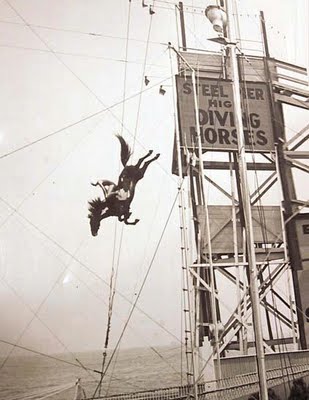
I didn’t know which circus May traveled with, but I did find out what her act was—she was an equestrian high diver. Yes, you read that correctly. She would dive off a high platform, on a horse, into a pool of water.

I can still see the twinkle in her eye as she looked at me.

“That’s a lost art,” I  said. “I don’t know anyone who can dive horses.”

Then she gave my hand a squeeze, looked at me right in the eye and confided, “I think I can still do it. But I believe the horse is dead.”

Later, while looking through a book of old circus posters, I spotted one from the Ringling Bros. and Barnum & Bailey Circus. The picture was of a young girl standing next to a white horse. It was captioned “May Worth – The Greatest Bareback Rider Of All Time!” 

The Greatest Show on Earth. 

I never did know the patient’s  last name.

The greatest Dream on Earth.

God bless you, May.

Laughter Has No Accent!!

"Cramming."
photo courtesy George Taylor M.D.

In the 1990s, I had the opportunity to be part of a “Clown Exchange Program”  with Le Rire Medécin. This meant I got to go to Paris for three weeks and clown around in six different French hospitals in Paris and Nantes.

I am not fluent in French. Well, actually that’s an understatement. I can’t speak a lick. But I soon learned that laughter has no accent. Working there wasn’t as hard as I thought it was going to be. Not knowing the language forced me to be more creative.

My biggest lesson, however, came during my third and final week there. My wife Lesley came over, and we did the usual tourist stuff: art museums, sidewalk cafés. In the Musée D’Orsay, something clicked! We were looking at this gigantic painting of men in a life boat on a storm-tossed sea, fighting a giant serpent. And I asked myself,  “What was the artist thinking, painting such an enormous canvas? No one could hang it on the wall unless they lived in a castle. . .  He painted it without electric light to see . . .  Why would he put so much time and effort into one painting?”

Then I had my “aha” moment. That painting had lasted for centuries and was an amazing piece of art. My artistry is fleeting, but no less worthy. There’s only one reason I slather on the makeup and walk into walls: it’s the look on my audience’s face (be it one or many). Not a laugh, just a ” look” — this is proof of my artistry.  I put my heart and soul into what I do, and while that “look” only lasts for a split second, the moment will be in their hearts for a lifetime. It’s something money can’t buy.

On the merits of the “stand-up wiggle”

We met her on her first birthday, making clown rounds at the hospital. Every time she saw me her eyes would bug out and she would wiggle. I call this a “stand-up wiggle,” which is the highest accolade a clown can receive from a baby. I like to think this baby wiggled because she was excited to see me, but maybe it’s because she didn’t know how to clap yet? I’d sing “You Are My Sunshine” and she’d wiggle even more.

She had a very bad heart when she was born. On the day we found out she was going to get a heart transplant we were all so excited we were dancing in the halls. The mother was dancing, the nurses were dancing, the doctors were dancing, the clowns were dancing and the baby was wiggling–this was celebration time!

That was a Monday. On Wednesday, the transplant was done and I looked in on her through the window of her isolation room in the cardiac ICU.  There she was in all her nakedness, baring her stitches and wounds. She was under sunlamps to keep warm. The nurses had given her these fluorescent yellow sunglasses to protect her eyes, and she looked like a celebrity. On Friday, I noticed the baby’s name was missing from the patient board. I got excited. “Is she leaving the floor?” I asked.

The nurse said,” She’s sprouting wings. She is leaving us.”

We went ahead with our clown rounds, but when we passed the room where she had been in recovery, we broke down. My partner just couldn’t take it anymore and ran for the lounge and started to cry. I ended up in front of the isolation window, looking at the empty crib, singing “You are my sunshine” like a slow ballad.

When I finished, I turned to my left and her  father was standing next to my shoulder. He stood tall, and a tear was in his eye. He placed a hand gently on my shoulder and said softly, “Thank You.”

A special time and space.

Peep in a Cup

Here’s another Easter story. One day, while making my rounds with the “ether bunny,” I heard about a case of marshmallow chicks that had been donated to the hospital. Of course these couldn’t be given to the children because there is enough sugar in them to make your teeth itch. So-o-o, they were divided and distributed to the nurses’ stations. The staff likes sweets, just like anyone else.

So I decided to take a survey of how people eat marshmallow chickens. Some eat them whole, stuffing the entire confection into their mouth. Some bite the heads off first and some pick their eyes out! Not me. I just lick them and put them back!

I knew the nurses needed a little boost of laughter. They been having a particularly bad day. I took one of the marshmallow chicks and placed it in a urine specimen container.

I walked up to the charge nurse with it and said, “Someone ‘peeped’ in the cup and I don’t know whose it is!”

The nurse burst into laughter and immediately took the specimen bottle; placed it in a Ziploc bag and inserted that into one of those plastic containers that they use for sending money from the drive thru to the bank teller inside. . . Laughing, she said, “Let’s send it to the lab!”

All I could picture was a capsule with a frightened marshmallow peep winding its way through a maze of pipes as it made its way to the lab.

Moral: A joy shared is a joy multiplied.

Bunny Tales

It was Eastertime and I was doing my classic bit where I would take this 2-inch stuffed rabbit and do a little puppet routine on a table top. I would sing the “Hokey Pokey” and perform a little dance with the toy.

” You put your right foot in . . .You put your right foot out . . .” STOP.

I would look around the room, sniff the air, and continue: ” You put your left foot in . . . You put your left foot out.” STOP.

I’d pick up the rabbit, smell it, and make a face as though I’d just noticed a foul odor.

Then, I would ask the person next to me to smell the rabbit and tell me if they thought it smelled  funny. In most cases people were hesitant to sniff. They were afraid that it was going to squirt water at them. However, I assured them that it wouldn’t.

When they finally placed it to their nose, I asked. “Does it smell funny?”

“No.”

“It should. It’s the ETHER BUNNY!”

Screaming Baby Lullaby

My banjo teacher always said, ” When all else fails, slay’ em with a waltz.” So as a compassionate, non-violent clown, I do my own version of this. I’ve discovered that singing or just humming a good old-fashioned hymn or lullaby will calm just about anyone who is within earshot, especially at a children’s hospital.

Music is said to be the voice of angels. Well, it’s the voice of hospital clowns, too! We have used music to bring heart rates from 170 down to 115; in other cases we have raised dangerously low blood pressure by dancing around to the marches we play on our ukuleles and cheap kazoos.

One time, after a performance in one room in the ICU, we were told, “We need one of those over here.”

At a local hospital where I live, they play the Brahms lullaby over the PA system every time a baby is born. It gives everyone a warm, fuzzy feeling. And it proves my point.

Nursing Notes from Nurse B.B.


That's me, front and center with the other clowns at Children's Hospital Boston! Photo Courtesy George A. Taylor, M.D.

Heartstrings

The clown’s work not only brings laughter, it sometimes brings tears. Tears of joy and tears of sadness.

Tears and laughter are attached together to the same heartstring.

We have all laughed till we cried, and cried so much that we started laughing.

We sometimes laugh at a child’s tears, but other times their giggles and laughs make us cry.

_______________________________________________________________

Through my work at Children’s Hospital Boston, I was privileged to see firsthand the effect of humor on the healing process. The hospital, which was founded in 1869, is the pediatric teaching hospital for Harvard Medical School. Its first year, it had 69 patients. Take a look at some more current (the year 2000) mind-blowing statistics:

  • 17,599 Discharges
  • 3,447 Observation Days
  • 19,434 Inpatient Surgical Procedures
  • 10,815 Ambulatory Surgical Procedures
  • 258,740 Clinic Visits
  • 51,948 Emergency department visits (not including parents, grandparents, or guardians)
  • 900 nurses & patient service staff
  • 791 Attending medical and dental staff
  • 671 Residents and fellows
  • 988 Nurses
  • 2,317 Other full-time employees
  • 516 Other part time employees
  • 509    Volunteers
  • 365 inpatients beds
  • 11 floors of clinics
  • 8 Clowns!!!!!!

So if the clowns see only 1 shift of Medical/Dental/House/Nursing staff and Volunteers, plus the 19,000-odd kids going to surgery, not to mention a few thousand parents, nannies and people asking for directions, I’d say our quick census count is “Up There!”

My mantra…

Babies cry before they laugh.

Tears show that there is a child within us

who will never grow old.

Laughter is that inner child’s heartbeat.

Smiles and looks of wonder

are signs of life.